How is decaf coffee made?
Published 9 October 2026 · Vogue Cafe, Steveston Village
Green beans, regulated solvents or water, and about 3 mg of caffeine left in the cup: how decaf coffee is made, with Canadian sources.
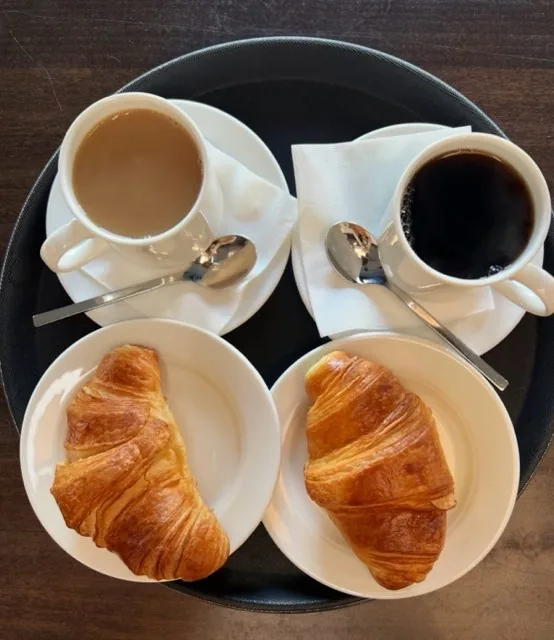
Decaf has a reputation problem. Some people assume it's chemically stripped, some assume it has no caffeine at all, and some assume it can't taste good. None of those is quite right. Here's how decaf coffee is made, what's actually left in your cup, and what Canadian rules say about it, using Health Canada and the decaffeinator itself as sources. One of the world's best-known decaf processes happens just across the river from us in Delta.
How is decaf coffee made? The short answer
Coffee is decaffeinated while the beans are still green, before roasting. The beans are soaked or moistened so the caffeine can move, then the caffeine is drawn out with either a solvent or water, and the beans are dried and sent on to be roasted like any other coffee. The big differences between methods are what does the drawing out, and how much of the coffee's flavour stays behind.
In Canada, the rules for solvents are set by Health Canada. Its List of Permitted Carrier or Extraction Solvents allows two solvents for decaffeinating coffee:
| Solvent permitted by Health Canada | Residue limit in the finished coffee |
|---|---|
| Dichloromethane (methylene chloride) | Not to exceed 10 ppm in decaffeinated roasted coffee and decaffeinated instant coffee |
| Ethyl acetate | Not to exceed 10 ppm in decaffeinated roasted coffee and decaffeinated instant coffee |
So solvent-processed decaf sold in Canada is regulated, with a residue limit of 10 parts per million. If you'd rather avoid solvents entirely, there are water-based methods too.
The water method, made in Delta, BC
Swiss Water Decaffeinated Coffee Inc. is based at 7750 Beedie Way in Delta, BC, a short drive from Steveston. The company says its process was originally developed as the first-ever alternative to chemical decaffeination, and that it never uses chlorinated solvents or esters. In its own words, it uses "only water, temperature, and time".
The company describes four steps:
- Preparation and hydration. Green coffee beans are cleaned, then hydrated, which expands them and prepares them for decaffeination.
- Caffeine migration. The beans meet what the company calls Green Coffee Extract (GCE): water carrying coffee's soluble compounds but no caffeine. Because the extract already holds the other compounds, diffusion moves the caffeine out of the beans while the flavour compounds stay in.
- Drying. The beans are dried with high air flow at low temperatures.
- Filtration and renewal. The caffeine-loaded extract runs through carbon filters that trap the caffeine, and the refreshed extract goes back to work on the next batch, in a closed loop.
The company also says the process keeps coffee certifications such as Organic intact, which it notes solvent processes can't promise.
Why the extract trick works
If you soaked beans in plain water, everything soluble would wash out: the caffeine, but also the sugars and acids that make coffee taste like coffee. Soaking them in water that is already full of those compounds means only the caffeine has somewhere to go. It's the same reason a sponge already full of water won't soak up more.
How much caffeine is left in decaf?
Decaf is low in caffeine, not zero. Health Canada lists the caffeine content of common foods and drinks:
| Drink (8 oz / 237 ml) | Caffeine per Health Canada |
|---|---|
| Roasted and ground decaffeinated coffee | 3 mg |
| Instant decaffeinated coffee | 5 mg |
| Regular coffee, depending on how it's made | 76 to 179 mg |
For context, Health Canada recommends a maximum of 400 mg of caffeine a day for healthy adults, and 300 mg a day for women who are pregnant, breastfeeding or planning a pregnancy. A couple of decaf drinks barely register against those numbers, which is why decaf is a good afternoon or evening choice.
Does decaf taste different?
It can. Every decaffeination method changes the bean a little, and how the coffee is roasted afterwards matters just as much as the method. A well-made decaf pulled as espresso and steamed into a latte is hard to tell apart for many people, especially with milk. If you find decaf flat, try it as a cappuccino or latte before giving up on it; milk rounds out the cup. Our French brunch guide explains why a coffee and a pastry is the classic way to start.
Three decaf myths
Ask a table of friends "how is decaf coffee made?" and you will usually hear one of these three myths.
- "Decaf has no caffeine." Health Canada lists about 3 mg in an 8 oz cup of roasted and ground decaf. Low, not zero.
- "All decaf is made with chemicals." Some is solvent-processed under Health Canada's 10 ppm residue limits; water-based processes like the one in Delta use no solvents.
- "Decaf is decaffeinated after roasting." It's done to green beans, before roasting.
Decaf at Vogue Cafe
Decaf is available at our espresso bar, so any of our espresso drinks, from an americano to a latte or cappuccino, can be made decaf. If you want to know which decaf we're pouring this week, just ask at the bar. Pair it with a butter croissant or one of our house-made tarts after dinner, and you'll still sleep tonight. The full drinks list is on our menu.
We're at 12251 No 1 Rd #130 in Steveston Village, open daily 10:30am to 8:30pm. Now you know how decaf coffee is made, come and taste one.
Frequently asked questions
How is decaf coffee made?
Coffee is decaffeinated while the beans are still green, before roasting. The caffeine is drawn out with either a permitted solvent or a water-based process, then the beans are dried and roasted like any other coffee.
How much caffeine is in decaf coffee?
Health Canada lists about 3 mg of caffeine in an 8 oz cup of roasted and ground decaffeinated coffee and 5 mg in instant decaf, compared with 76 to 179 mg in regular coffee.
Which solvents are allowed for decaf in Canada?
Health Canada permits dichloromethane and ethyl acetate for decaffeinating coffee, each with a residue limit of 10 ppm in decaffeinated roasted and instant coffee.
Is the Swiss Water Process chemical-free?
Swiss Water says its process uses only water, temperature and time, and never uses chlorinated solvents or esters. The company is based in Delta, BC.
Can I get decaf at Vogue Cafe?
Yes. Decaf is available at our espresso bar, so any espresso drink can be made decaf. Ask at the bar which decaf we're pouring.
Vogue Cafe · Steveston Village
Open daily 10:30am–8:30pm · brunch until 3pm · licensed until midnight for special bookings
12251 No 1 Rd #130, Richmond BC · (604) 370-4444
Reserve a Table