Walking Britannia Shipyards Steveston
Published 20 October 2026 · Vogue Cafe, Steveston Village
A cannery, a shipyard and a segregated waterfront village on pilings: what each building at Britannia Shipyards National Historic Site holds, and how to plan a visit.
Most visitors see the cannery and the wharf and head home. Walk east along the river for about a quarter of an hour and you reach something quieter: weathered buildings on pilings, joined by a wooden boardwalk, where a cannery became a shipyard and several communities lived side by side but apart. Here is the history, what each building holds, and the practical details for a Britannia Shipyards Steveston visit, drawn from the official site pages.
Britannia Shipyards Steveston in brief
Britannia Shipyards National Historic Site is an eight-acre (3.2 hectare) heritage park on the Fraser River, designated a national historic site in 1992. It is owned and operated by the City of Richmond with support from the Britannia Shipyards National Historic Site Society. The site sits along Cannery Channel, a 3 km stretch of shoreline running from Garry Point in the west to London Farm in the east. It was once a complex of more than 90 structures; what survives is a sampling chosen to show how people worked and lived at a twentieth-century West Coast cannery and shipyard.
From cannery to shipyard: the history
The cannery years
The main building went up in 1889 as the Britannia Cannery, built on piles over the river in the L-shaped plan common to early canneries. The official history says that before it was even finished, the first tall ship to arrive in Steveston docked here and loaded the first shipment of canned salmon bound for Europe, which began the tall-ship era that earned Steveston the name "salmon capital of the world". By 1900, Britannia was one of fifteen canneries along Cannery Channel. It and the neighbouring Phoenix Cannery belonged to the Anglo-British Columbia Packing Company, founded by Henry O. Bell-Irving.
Output along the Fraser began a slow decline from 1901, through overfishing and competition. Then came the Hell's Gate disaster in the Fraser Canyon in 1912 to 1913 (the site's pages mention both blasting operations and a landslide). The salmon run failed, and many canneries closed or changed use.
The shipyard years
In 1917 and 1918 Britannia was converted into a shipyard and repair facility for the company's fishing fleet, with a large opening cut for a slipway so boats could be hauled straight in from the water. The site describes it as the largest shipyard where employees could work under cover. It ran for more than 60 years: the Canadian Fishing Company bought it in 1969, BC Packers took over in 1979, and operations shut down by 1980. After sitting empty, it came to the City through a land exchange with a developer.
The people who lived and worked here
The official history doesn't soften this part. As the industry grew, immigrants arrived from around the world and Indigenous people were displaced. Cannery jobs were divided by race for most of the twentieth century: foremen, mechanics and office jobs went to workers of European descent, while Indigenous, Chinese and Japanese workers did the harder labour on the processing lines. Housing was segregated too.
- Indigenous workers. In the early days Indigenous people came from along the BC coast; men fished for the canning companies and women worked inside the cannery.
- Chinese workers. The site says about 1,000 Chinese immigrants worked in local canneries, hired through Chinese labour bosses who negotiated low wages with the companies each season.
- Japanese Canadians. Japanese fishermen began arriving in the late 1800s, and by the 1930s about 3,500 Japanese people lived in Steveston, many families working in the fishery.
- European workers. Single white fishermen and seasonal labourers bunked together; the manager's family had a large house.
The Province of British Columbia's heritage listing for Steveston, on the Canadian Register of Historic Places, names the Murakami Boatworks and Britannia Shipyards among the places that illustrate Japanese Canadian boat building. Because the history of Japanese Canadian property ownership was largely erased across BC, it calls Steveston's surviving buildings provincially significant.
Building by building
These are the buildings and exhibits as Steveston Heritage Sites names them.
Britannia Shipyard building
The 1889 cannery and the heart of the site. Its exhibit, "Industry on the Waterfront", recreates the shipyard, carpentry shop, engine shop and machine shop with original machinery and tools. The historic MV Burnaby was moved into the restored slipway in May 2023, and the building reopened in June 2026 after a year-long restoration. It stands over water and may close seasonally for high tides.
Murakami House and Boatworks
Otokichi and Asayo Murakami and their 10 children lived here from 1929, part of a community of 250 Japanese families on the waterfront. Otokichi built about two boats each winter; Asayo worked in canneries and on farms. In 1942 the family was forcibly uprooted, along with more than 22,000 Japanese Canadians. Japanese Canadians weren't allowed back to the coast until 1949, and the Murakamis chose to farm on the prairies instead. The house and boatworks opened to visitors in May 1998, with exhibits built from the family's own information and artefacts.
Richmond Boat Builders
Built in the 1930s by the Kishi family, who crafted 24 and 26 foot wooden gillnetters here, sometimes four at once. The steambox, boiler and boat ways are still intact, and live restoration work, including on the Crystal S, carries on inside. The Silver Ann, built in 1969, was the last wooden gillnetter made in the building.
Chinese Bunkhouse
Built around 1915 for Chinese workers at the Glendale Cannery in Knight Inlet and later brought to Britannia by water, it is described as the last surviving Chinese bunkhouse on the West Coast. Up to 100 men ate in the ground-floor mess hall; upstairs were cramped sleeping quarters. The upper-floor exhibit covers the late 1880s to the 1920s and includes a 9-minute documentary, Hardship and Hope: The Chinese Cannery Workers of Steveston.
Historic stilt houses
Houses like these were "knock down houses", built at New Westminster sawmills in the 1880s and floated down the Fraser on scows to be reassembled. The group includes the Manager's House (based on the Shorey family, who lived at Britannia until 1960), the Men's Bunkhouse, and the Point House, believed to have been the home of Musqueam Chief James Point and his family. A short film, These Walls Can Talk, explains the different housing styles.
Seine Net Loft
Built in 1955 over the water for net making and repair, with four exhibits on fishing and boatbuilding innovation. It is closed for restoration from spring 2026 to fall 2027, according to its page.
Planning your Britannia Shipyards Steveston visit
| Detail | What the official site says |
|---|---|
| Address | 5180 Westwater Drive, east of Steveston Village |
| Grounds | Open dawn to dusk; building hours change by season |
| Admission | Free |
| Transit | From Richmond-Brighouse Station, bus 401, 402, 406 or 407 to Railway Ave and Moncton St, then about a 10-minute walk |
| Bikes | Not allowed on the boardwalk; racks at Murakami House and the Administration Office |
| Rules | No food or drink in the buildings, no smoking in the park, only service animals inside buildings |
Building hours are longer in summer and shorter in fall and winter, so check the Plan Your Visit page first. Interior photos are fine as long as you don't set up equipment or block paths; portrait or wedding shoots need permission. Groups can arrange guided tours by calling 604-238-8037.
Programs worth knowing about
- Voyage of the Gikumi: a two-hour heritage trip on a restored 1954 workboat on select summer days, for ages 8 and up. The 2026 sailings sold out.
- Guided tours and 3D virtual tours of several buildings.
- Adventures at Britannia Shipyards: a free activity booklet for kids 6 to 12.
Make a day of it
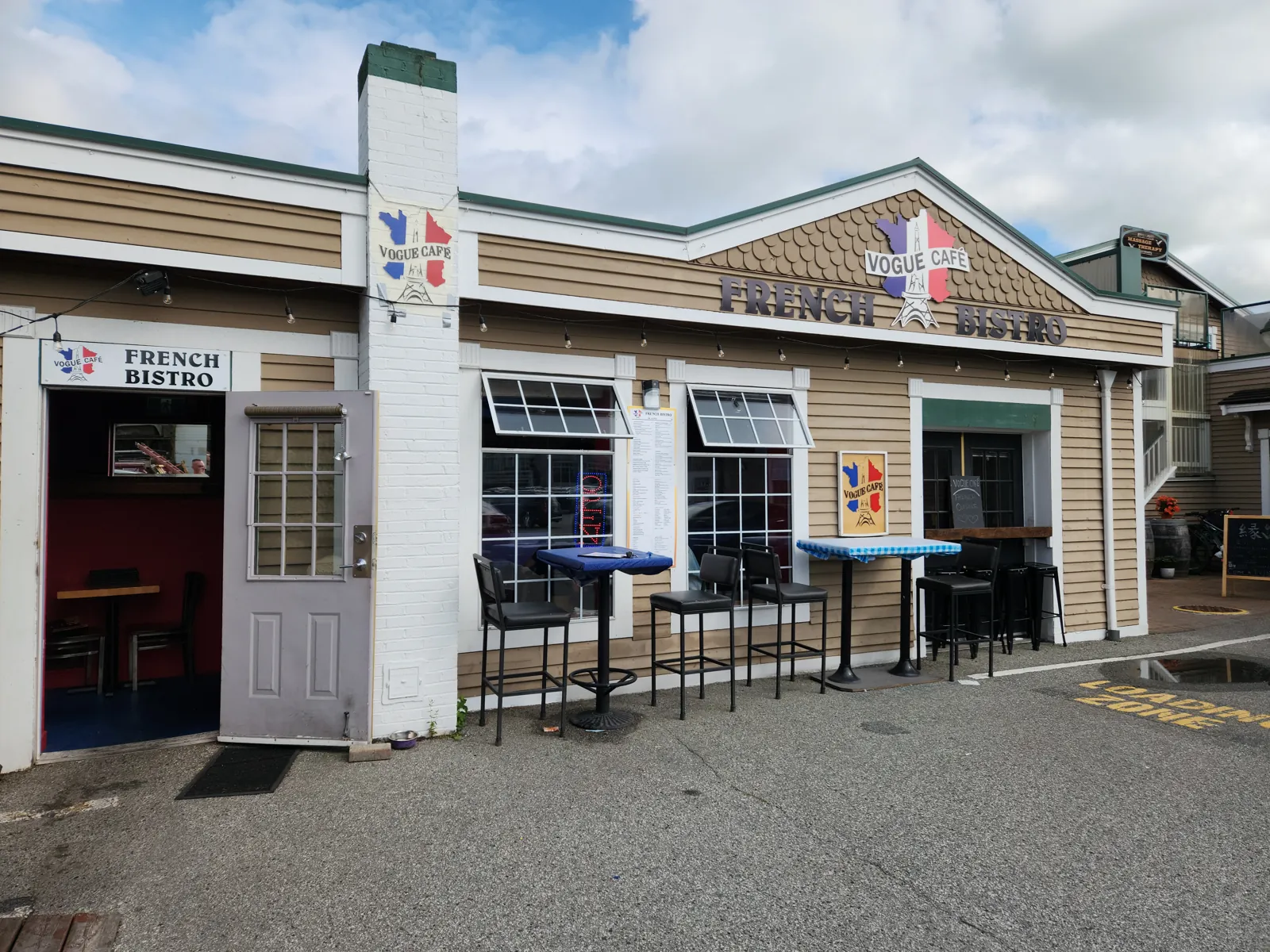
Britannia pairs naturally with the waterfront: walk west along the river to the village, then on to Fisherman's Wharf, where boats still sell their catch, or use our Steveston walking guide for the rest of the heritage sites. When it's time to sit down, Vogue Cafe is a French bistro at 12251 No 1 Rd #130 in the village, open daily from 10:30am, with brunch until 3pm and a covered side patio. A bowl of French onion soup after a cold morning on the boardwalk is hard to beat; the full menu is online.
Britannia Shipyards FAQ
Is Britannia Shipyards free?
Yes. Steveston Heritage Sites lists free admission to the grounds and free entry to the heritage buildings. Some special programs, such as the summer boat voyages, are ticketed.
How far is Britannia Shipyards from Steveston Village?
The site is at 5180 Westwater Drive, east of the village. Steveston Heritage Sites says it is about a 15-minute walk from the village, or 5 to 10 minutes by car or bike.
Is there parking at Britannia Shipyards?
Yes. Parking is free in two lots and on the street. The paved west lot has marked accessible stalls, and the gravel northeast lot has two electric vehicle charging ports that charge an hourly fee.
Are all the buildings wheelchair accessible?
All the heritage buildings are accessible except the second floor of the Chinese Bunkhouse, which is reached by stairs. The boardwalk and some wooden floors can be uneven, and accessible washrooms are in the northeast corner behind the stilt houses.
Why are some buildings closed when I visit?
Buildings that stand on pilings over the water, such as the Britannia Shipyard building and the Seine Net Loft, can close because of high tides or maintenance. The site suggests checking signage or calling 604-238-8050 on the day.
Vogue Cafe · Steveston Village
Open daily 10:30am–8:30pm · brunch until 3pm · licensed until midnight for special bookings
12251 No 1 Rd #130, Richmond BC · (604) 370-4444
Reserve a Table