Buying at Steveston Fisherman's Wharf
Published 13 October 2026 · Vogue Cafe, Steveston Village
How the public sales float really works, what the boats sell in each season, and what to check on a vendor's whiteboard before you hand over your money.
Walk down the ramp from the boardwalk at the foot of the village and you are on a floating dock lined with working boats, each with a hand-written whiteboard and a cooler or two on deck. That is the public sales float, and it is the reason most people come to Steveston Fisherman's Wharf: to buy seafood straight from the people who caught it. It is also a place with rules, a season, and a few habits worth knowing before you show up with an empty bag. This guide sticks to what the Steveston Harbour Authority, which runs the harbour, actually publishes.
What Steveston Fisherman's Wharf actually is
Steveston Harbour sits on the south arm of the Fraser River at the south end of Richmond. The Steveston Harbour Authority describes it as home to more than 500 commercial fishing vessels across more than 17.5 hectares, which makes it the largest small craft commercial fishing harbour in Canada. The harbour has two main sites, Paramount and Gulf of Georgia. The wharf the public knows is at the Gulf of Georgia site, south of Bayview Street in the middle of the village.
The harbour authority is a non-profit set up in 1990. It leases the harbour from the Small Craft Harbours Branch of Fisheries and Oceans Canada, with a mandate to run it as a commercial fishing harbour. Its board includes fishing groups, the City of Richmond, community groups and the Musqueam First Nation. The docks exist for the fleet first; the sales float is the public's window onto it.
How the sales float came to be
According to the harbour authority's short history, boats began selling to the public unofficially in the 1970s from "C" float on the 3rd Avenue Pier. That float wasn't built for crowds and had no quality rules, so Fisheries and Oceans Canada formed a committee of health officials and fishers to write guidelines. A purpose-built public sales float went in in 1989, at the same time as the Steveston Landing development.
Who can sell, and what the rules say
The float runs under the harbour authority's Operations Directive #1, published on its website. A few rules explain most of what you'll see:
- Licensing. Every seller needs a valid Fisheries and Oceans Canada licence for each species on offer, and must display a provincial fish vending licence where the public can see it.
- No cleaning on the float. Gutting, cutting or processing product is prohibited within the harbour. Any dressing has to be done before the boat arrives, so buy with that in mind.
- No bivalves. Oysters, clams, mussels and scallops can't be sold. Crab must be sold alive.
- Temperature. Freshly caught fish must be kept at about 4°C, and display areas must be covered with a tarp.
- Thawed product is labelled. Flash-frozen fish that has been thawed can only be sold if it is clearly marked "previously frozen" and held between 0°C and 4°C.
- Scales. Vendors selling by weight must use a scale approved for trade, in the directive's words "approved by Industry Canada".
- Packaging. Food-grade bags only. A garbage bag is fine as an outer layer for strength.
Prices are set by each vendor, and every purchase is a private deal between you and the seller. The harbour authority does not regulate prices or quality; it says plainly that it is not a health authority.
Reading the whiteboard before you buy
The single most useful thing on the float is the whiteboard each boat must display. The harbour authority provides these boards, and they must list:
- the species for sale
- the vessel it was caught on
- where it was caught
- when it was caught
- whether it is fresh or frozen
If a boat isn't showing that information, the harbour authority says the vendor is breaking the conditions of selling on the float and strongly advises buying from someone else and reporting it (numbers in the FAQ below).
Fresh or frozen?
The harbour authority's purchasing tips page explains that "fresh" simply means never frozen: kept chilled, often in a slush of ice and salt water, since harvest. Quality drops with age, and its general rule is to be wary of "fresh" product more than a week past harvest, though that varies by species. Hence the date on the whiteboard.
"Frozen" usually means flash frozen at sea, within hours of harvest. Frozen fish should be hard as ice with no sign of thawing. Ask whether the vessel has a commercial freezer on board, and if not, where the fish was frozen; the directive requires an on-board freezer holding -18°C for boats selling flash-frozen catch.
The authority's bottom line: fresh versus frozen matters less than how well the vendor knows the product and how clean the boat and gear are.
What's in season at Steveston Fisherman's Wharf
The harbour authority's "What's in season?" list, as published (it notes that flash-frozen fish can turn up year round):
| Species | Season, per the harbour authority |
|---|---|
| Spot prawns | May to June |
| Albacore tuna | June to October |
| Pink salmon | July and August |
| Sockeye salmon | July, August, September |
| Chum salmon | July to November |
| Coho salmon | Very limited; varies year to year, sometimes not at all |
| Halibut | February to November |
| Dungeness crab | Year round, with rotating closures by area |
| Shrimp | Year round, with rotating closures by area |
| Rockfish | Year round, with rotating closures by area |
| Sablefish (black cod) | Year round |
| Sole | Year round |
| Sea urchin | Year round |
A season on paper isn't a guarantee on the dock; openings are set by Fisheries and Oceans Canada and depend on what the boats bring in. The harbour authority's Fisherman's Wharf page posts a daily note on what's available. When we looked in early October 2026 it listed salmon, shrimp in various sizes, squid, octopus and tuna.
A practical checklist for buying off the boats
Before you leave home
- Pack a cooler or an insulated bag with ice packs. The harbour authority warns that leaving seafood in a car on a hot day greatly speeds up spoilage and may make it unsafe to eat.
- Bring some cash as a backup. The harbour authority doesn't say how vendors take payment, and since every sale is a private deal, ask the boat before you choose.
On the float
- Walk the whole float first and compare whiteboards before you commit.
- Only buy seafood displayed on ice, as the harbour authority advises.
- Pick a vendor with a clean boat who can explain how the catch was handled.
- For crab, look for live animals held in clean water.
Etiquette and safety
This is a working dock: give crews room, keep children close, and don't step onto boats unless invited. The directive also says animals are not permitted on the sales float.
The bigger issue is wildlife. The harbour authority has warned about a wild sea lion that people were feeding at the public float; in one incident a little girl sitting on the bull rail was pulled into the water, though nobody appears to have been hurt. Feeding wildlife is illegal and dangerous, and the authority points to the federal Marine Mammal Regulations, which say no person shall disturb a marine mammal. Watch from a distance, stay off the bull rail, and never feed anything.
Time it with the rest of the village
What's on offer depends on which boats are in. The wharf is a few minutes on foot from the Gulf of Georgia Cannery, and our walking guide to Steveston strings it together with the heritage sites, while the Britannia Shipyards guide covers the boatbuilding side of the same story.
One simple tip: make the fish your last stop, not your first. Eat first, then buy and head straight home with the cooler.
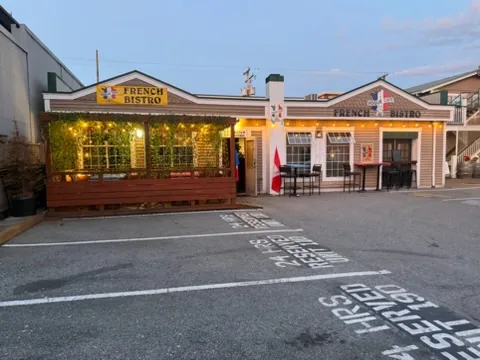
That's where we come in. Vogue Cafe is a French bistro at 12251 No 1 Rd #130 in Steveston Village, open daily 10:30am to 8:30pm with brunch until 3pm. Have a croque madame or a bowl of French onion soup à l'ancienne, look over the menu, or see our notes on lunch in Steveston Village and the boardwalk area. Then walk back to the float with an empty cooler and a full stomach.
Steveston Fisherman's Wharf FAQ
Where exactly is Steveston Fisherman's Wharf?
It is the public fish sales float at the Steveston Harbour Authority's Gulf of Georgia site, south of Bayview Street in the centre of Steveston Village. The harbour authority says the wharf is open seven days a week.
How do I know what's for sale before I go?
Check the Fisherman's Wharf page on the Steveston Harbour Authority website, which posts a daily note on what the boats have. Prices and quantities are only available at the float itself, not by phone or online.
Can you buy oysters, clams or mussels at the wharf?
No. The harbour's sales float directive does not permit the sale of bivalve shellfish, which covers oysters, clams, mussels and scallops. Live crab is allowed, and it must be held in clean water.
When is spot prawn season at Steveston?
The Steveston Harbour Authority lists spot prawns as in season from May to June. Like every fishery, openings are set by Fisheries and Oceans Canada, so the exact days change from year to year.
Who do I call if a vendor isn't following the rules?
The Steveston Harbour Authority asks you to call its main office at 604-272-5539 during business hours, or its on-duty operations staff at 778-228-9259 after hours and on weekends.
Vogue Cafe · Steveston Village
Open daily 10:30am–8:30pm · brunch until 3pm · licensed until midnight for special bookings
12251 No 1 Rd #130, Richmond BC · (604) 370-4444
Reserve a Table